(865)-247-8888
When to Switch From AC to Heat in Knoxville (and How to Get Ready)
Key Points
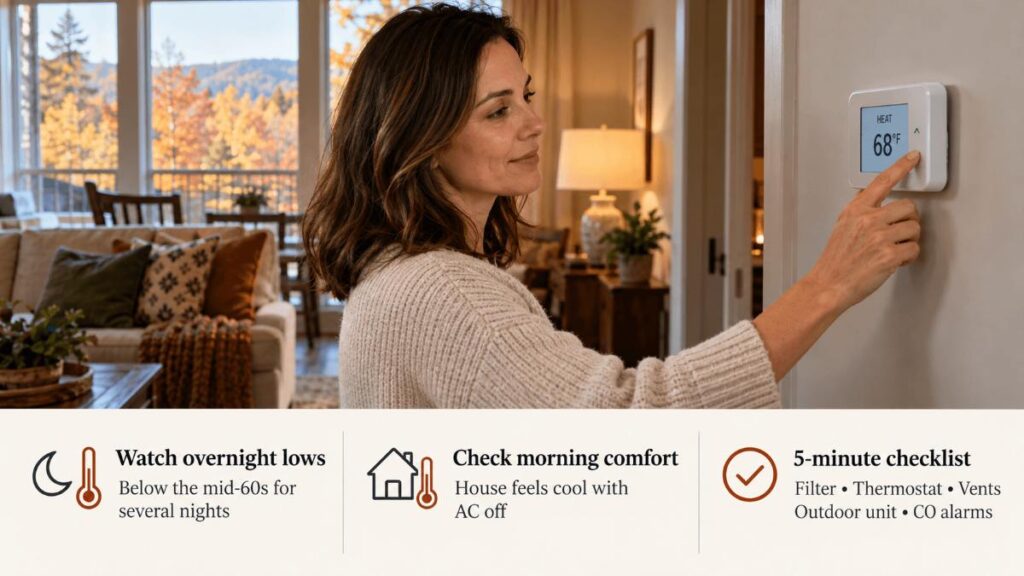
- Watch overnight lows, not the calendar. Switch when lows stay below the mid-60s for several nights in a row.
- Knoxville’s median first frost is October 24, so aim to be switched over and checked out before then.
- Run a five-minute checklist first: filter, thermostat, vents, outdoor unit, and carbon monoxide alarms.
- Heat pumps and mini-splits switch differently than furnaces, and each mini-split zone needs its own setting.
Introduction
Knowing when to switch from AC to heat in Knoxville depends on overnight lows, not the calendar. Switch when lows stay below the mid-60s for several nights in a row, and your house feels cool in the morning with the AC off.
Switch too early and the next warm, humid afternoon leaves the house muggy. Wait too long, and you’re shivering, or running the AC and the heat in the same week.
This guide covers the signs it’s time, a five-minute fall HVAC checklist, how to change your thermostat, what’s normal on the first run, and how heat pumps and mini-splits differ.
When to Switch From AC to Heat in Knoxville: What Do Overnight Lows Tell You?
Look for several nights in a row with lows below the mid-60s. The National Weather Service puts Knoxville’s median first frost at October 24 and median first freeze at November 2, based on 1991-2020 normals, so plan to be ready before then.
The mid-60s trigger is a rule of thumb, not an official standard. Fall here swings enough that one cold front is often followed by a warm, humid week. If you shut the AC off after the first front, the house sits unconditioned on the warm days that come back. Setting the thermostat to Auto lets the system handle those swing days.
What Should You Check Before You Switch From AC to Heat?
Five minutes of checking now heads off most first-week service calls.
Filter, Vents, and Registers
Replace or inspect the filter. One left in since spring is a common reason a system struggles on its first run. Then clear furniture and storage boxes that drifted in front of vents and registers over the summer.
Thermostat and Outdoor Unit
Put in fresh batteries if your thermostat takes them, and confirm it reads the room temperature correctly. Clear leaves, pine straw, and yard debris from the outdoor unit. That matters most for heat pumps, which heat from the outdoor unit.
Carbon Monoxide Alarms and Annual Service
The CDC says to check CO detector batteries when you change your clocks each spring and fall and to replace the alarm every 5 years or as the manufacturer directs. Clocks fall back on November 1 this year. The CDC also recommends having your heating system serviced by a qualified technician every year.
How Do You Switch Your Thermostat From Cooling to Heating?
For most homes, the switch takes less time than the checklist:
-
-
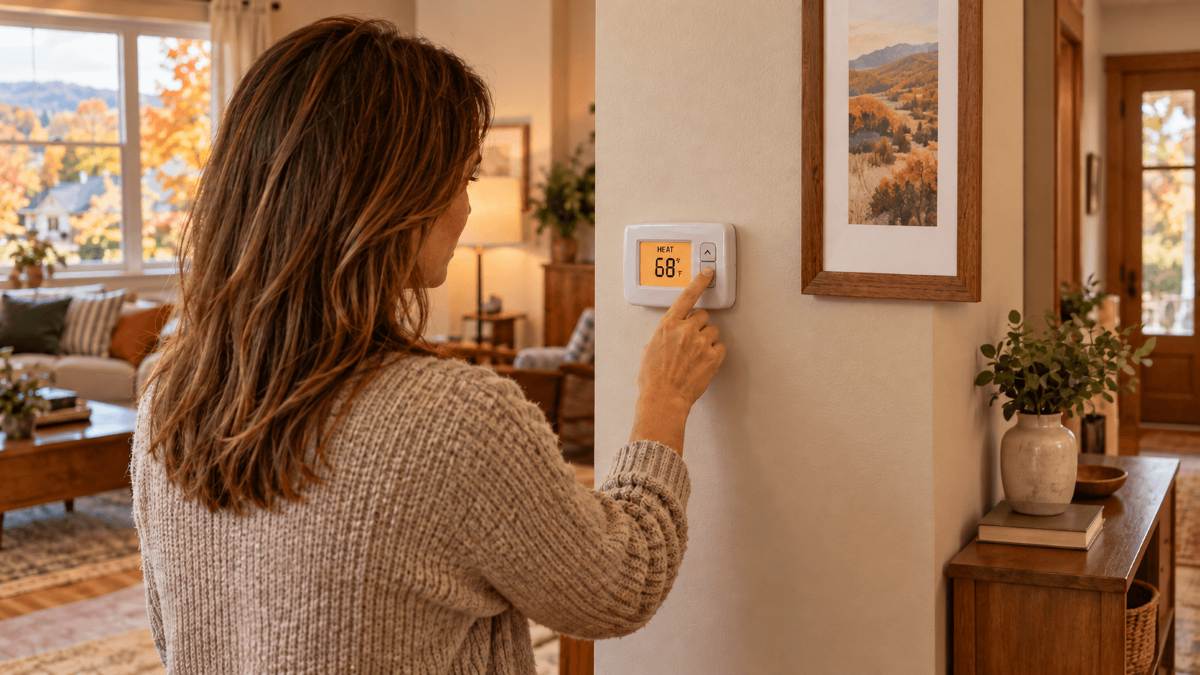
- Set the mode. Change the thermostat from Cool to Heat, or to Auto if it has that option.
- Raise the setpoint in steps. Go up two or three degrees at a time instead of jumping straight to your target.
- Update your schedule. Summer settings rarely fit how you use heat. The Department of Energy says setting your thermostat back 7 to 10 degrees for 8 hours a day, while you’re away or asleep, can cut as much as 10 percent a year off your heating bills.
- Check every zone. If you have a mini-split, switch each unit separately.
-
Furnace Smell the First Time You Turn On the Heat: What’s Normal?
A faint dusty smell and a short wait before warm air arrives are normal. Dust that settled on the heating components over the summer burns off as the system warms up, and the smell fades as it runs.
These are not normal and call for heating repair:
-
- A smell that lingers, gets stronger, or smells like plastic
- A system that won’t start no matter what the thermostat says
- A breaker that trips the moment the system kicks on
If you ever smell gas, leave the house and call your gas utility or 911 from outside. We cover furnace troubleshooting step by step in.
Important Things to Know About Switching a Heat Pump or Mini Split to Heat
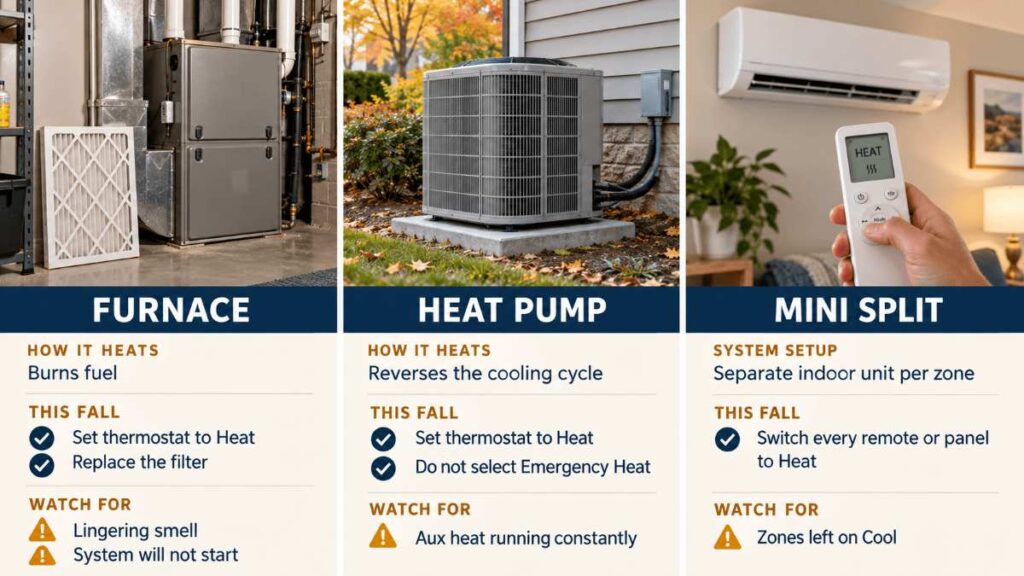
A furnace burns fuel to make heat, but a heat pump doesn’t. ENERGY STAR explains that a heat pump runs its cooling cycle in reverse, pulling heat from outdoor air and moving it inside. That’s why a heat pump thermostat has Emergency Heat and Aux Heat settings that furnace owners never see.
Auxiliary heat is a backup that kicks in during very cold snaps and defrost cycles, so seeing it run now and then is normal. Emergency Heat is for when the heat pump itself has stopped working. If aux heat seems to run constantly, have it checked through Chaffee’s heat pump services, since it often points to a refrigerant or airflow problem.
Mini splits add one more wrinkle: each zone has its own remote or wall panel. Say a household switches the living room unit to Heat but leaves two bedroom units on Cool. Those bedrooms stay chilly until someone changes each remote by hand. If you have a ductless mini-split system, switch every zone.
Furnace vs. Heat Pump vs. Mini Split: What Changes in Fall?
| System | How it heats | What to do this fall | Watch for |
| Furnace | Burns fuel | Set thermostat to Heat, replace filter | Lingering smell, no start |
| Heat pump | Runs the cooling cycle in reverse | Set to Heat, not Emergency Heat | Aux heat running constantly |
| Mini split | Separate indoor unit per zone | Switch each remote or panel to Heat | Zones left on Cool |
Should You Switch Now or Wait? Who Needs a Fall Tune-Up?
Switch now if lows have stayed below the mid-60s for several nights. Wait a few days if the forecast still shows warm, humid afternoons, and let Auto mode cover the swings.
Anyone can change the thermostat mode. A technician visit is worth it if it’s been over a year since your last heating inspection or if something acted up last winter. If your system was serviced within the past year and ran fine, you can likely skip straight to the checklist.
Expert Tips for When to Switch From AC to Heat in Knoxville
-
- Step the thermostat up gradually the first day you’re back in heat mode.
- Reverse your ceiling fans to spin clockwise on low, which pushes warm air near the ceiling back down.
- Label your HVAC breaker now, while everything works, so you’re not hunting for it later.
- Book a tune-up before the first frost. Our NATE-certified technicians are easier to schedule in early fall than after the first freeze.
Conclusion: When to Switch From AC to Heat in Knoxville
Knowing when to switch from AC to heat in Knoxville means watching overnight lows, running a short checklist, and knowing which quirks are harmless and which deserve a call.
If you’d rather hand it off, schedule a heating check with Chaffee HVAC, Plumbing and Electrical through our heating services page before the first frost.
For expert help you can trust, contact Chaffee HVAC, Plumbing, & Electrical in Knoxville today to schedule your no-obligation electrical safety inspection.
Frequently Asked Questions
Is there a set date for when to switch from AC to heat in Knoxville?
No. Switch when overnight lows stay below the mid-60s for several nights in a row. The National Weather Service puts the median first frost at October 24, so aim to be switched over by then.
What temperature should I set my thermostat to when I switch to heat?
Start at whatever feels comfortable and adjust a couple of degrees at a time. For savings, the Department of Energy says setting it back 7 to 10 degrees for 8 hours while you’re away or asleep can save as much as 10 percent a year on heating.
Why does my furnace smell the first time I turn on the heat?
A faint dusty smell during the first few minutes is normal, as summer dust burns off. A smell that lingers, gets stronger, or smells like plastic means you should turn the system off and call a technician.
Should I turn off my AC breaker for the winter?
Usually not. On some heat pumps, that circuit also feeds the auxiliary heat, so switching it off can leave you without backup heat. Ask a technician if you’re unsure how your system is wired.
How much does a fall heating tune-up cost in Knoxville?
The CDC recommends a qualified technician service your heating system every year.
What's the difference between heat and emergency heat on a heat pump?
Heat mode runs the heat pump normally and uses auxiliary heat automatically when needed. Emergency Heat forces the system onto backup heat only, so use it as a short-term measure when the heat pump has stopped working.
Can I switch to heat myself, or do I need a technician?
Changing the thermostat mode is a job any homeowner can do. Call a technician if it’s been over a year since your last heating inspection or if the system acted up last winter.

Contact Us
Chaffee HVAC, Plumbing, & Electrical
5725 Ball Camp Pike
Knoxville, TN 37921
865-247-8888 – Cooling/Heating
865-602-3552 – Plumbing
office@coolingheatingplumbing.com
About Us
Your local HVAC company, Chaffee, bring decades of experience to our work. What this means to you as a customer is that you can expect to receive the highest-quality professional service, regardless of your needs.