(865)-247-8888
Repair or Replace an Older HVAC System? A Knoxville Homeowner’s Guide
Key Points
- Age alone doesn’t determine whether an HVAC system should be replaced.
- Repair history, efficiency, and overall condition are equally important.
- Frequent breakdowns and rising energy bills may indicate replacement is the better long-term investment.
- A well-maintained older HVAC system may continue operating reliably after the right repair.
- Professional inspections help homeowners make informed repair-or-replacement decisions.
- Planning ahead can help avoid emergency HVAC replacements during peak seasons.
Introduction
Few home improvement decisions carry as much weight as deciding what to do with an aging HVAC system. When your air conditioner struggles through another Knoxville summer or your furnace needs yet another repair before winter, it’s natural to ask, “Should I repair my HVAC system, or is it time to replace it?”
The answer isn’t always straightforward.
Some older systems continue delivering dependable comfort for years after a well-planned repair. Others become increasingly unreliable, requiring more frequent service while driving up energy costs and making it harder to keep your home comfortable.
Rather than focusing on a single factor – such as the repair bill or the system’s age – it’s important to look at the entire picture. The equipment’s condition, repair history, efficiency, available replacement parts, and your long-term plans for your home all deserve consideration.
This guide explains how to evaluate those factors so you can make a confident decision based on what’s best for your home – not just today’s repair.
How Long Does an Older HVAC System Usually Last?
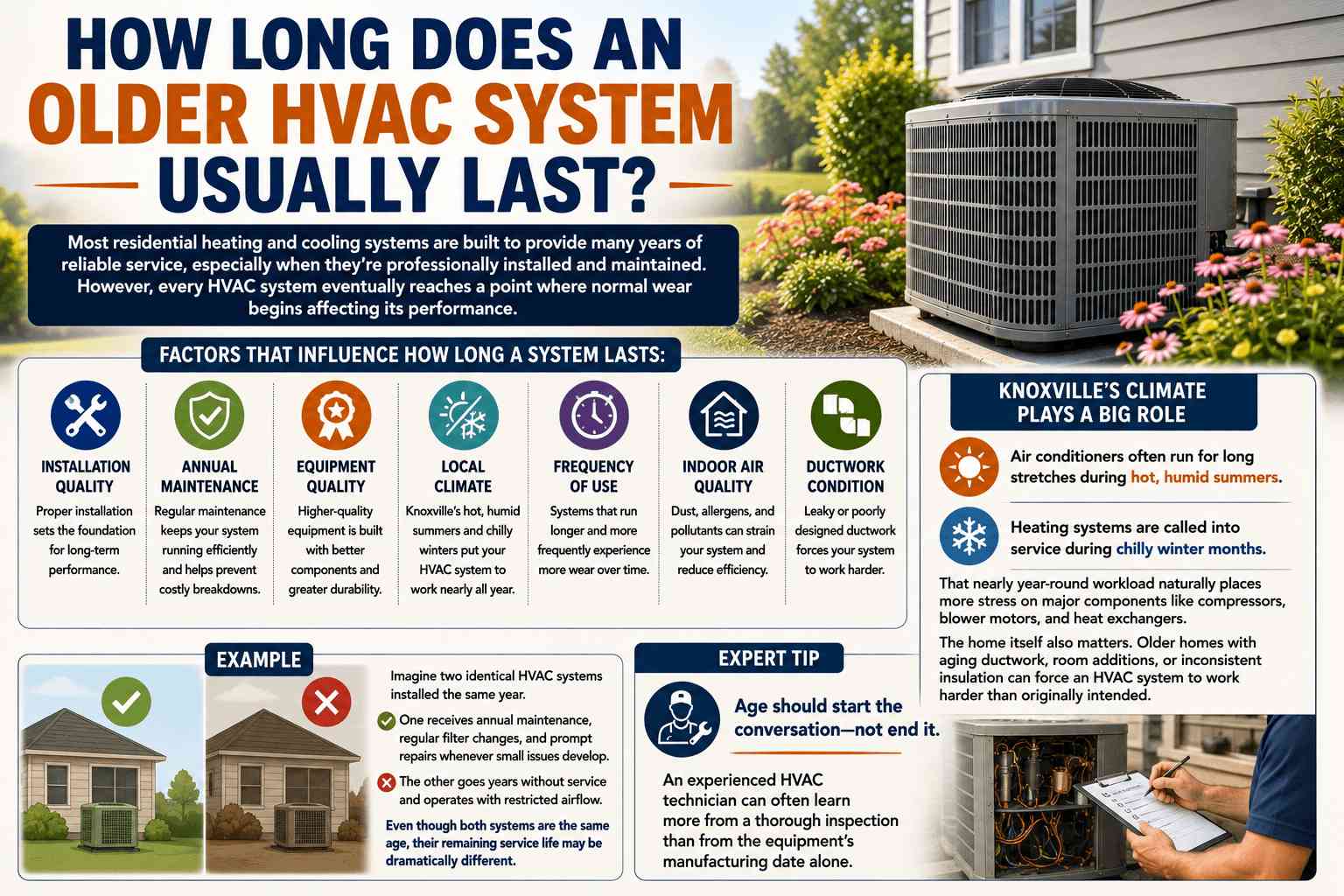
Most residential heating and cooling systems are built to provide many years of reliable service, especially when they’re professionally installed and maintained. However, every HVAC system eventually reaches a point where normal wear begins affecting its performance.
Several factors influence how long a system lasts, including:
- Installation quality
- Annual maintenance
- Equipment quality
- Local climate
- Frequency of use
- Indoor air quality
- Ductwork condition
For Knoxville homeowners, climate plays an important role. Air conditioners often run for long stretches during hot, humid summers, while heating systems are called into service during chilly winter months. That nearly year-round workload naturally places more stress on major components like compressors, blower motors, and heat exchangers.
The home itself also matters. Older homes with aging ductwork, room additions, or inconsistent insulation can force an HVAC system to work harder than originally intended.
Example
Imagine two identical HVAC systems installed the same year. One receives annual maintenance, regular filter changes, and prompt repairs whenever small issues develop. The other goes years without service and operates with restricted airflow. Even though both systems are the same age, their remaining service life may be dramatically different.
Expert Tip
Age should start the conversation – not end it. An experienced HVAC technician can often learn more from a thorough inspection than from the equipment’s manufacturing date alone.
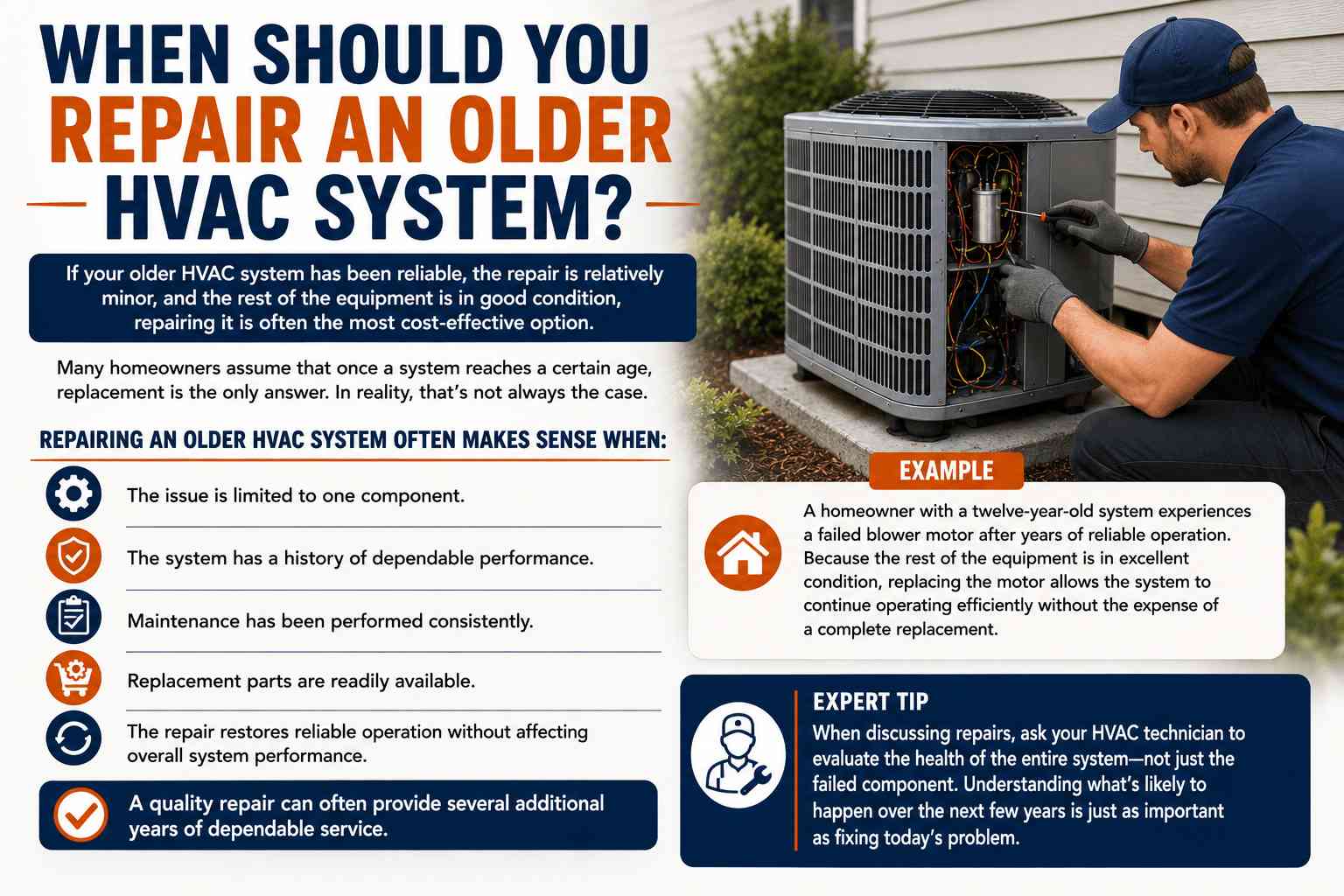
When Should You Repair an Older HVAC System?
If your older HVAC system has been reliable, the repair is relatively minor, and the rest of the equipment is in good condition, repairing it is often the most cost-effective option.
Many homeowners assume that once a system reaches a certain age, replacement is the only answer. In reality, that’s not always the case.
Repairing an older HVAC system often makes sense when:
- The issue is limited to one component.
- The system has a history of dependable performance.
- Maintenance has been performed consistently.
- Replacement parts are readily available.
- The repair restores reliable operation without affecting overall system performance.
A quality repair can often provide several additional years of dependable service.
Example
A homeowner with a twelve-year-old system experiences a failed blower motor after years of reliable operation. Because the rest of the equipment is in excellent condition, replacing the motor allows the system to continue operating efficiently without the expense of a complete replacement.
Expert Tip
When discussing repairs, ask your HVAC technician to evaluate the health of the entire system – not just the failed component. Understanding what’s likely to happen over the next few years is just as important as fixing today’s problem.
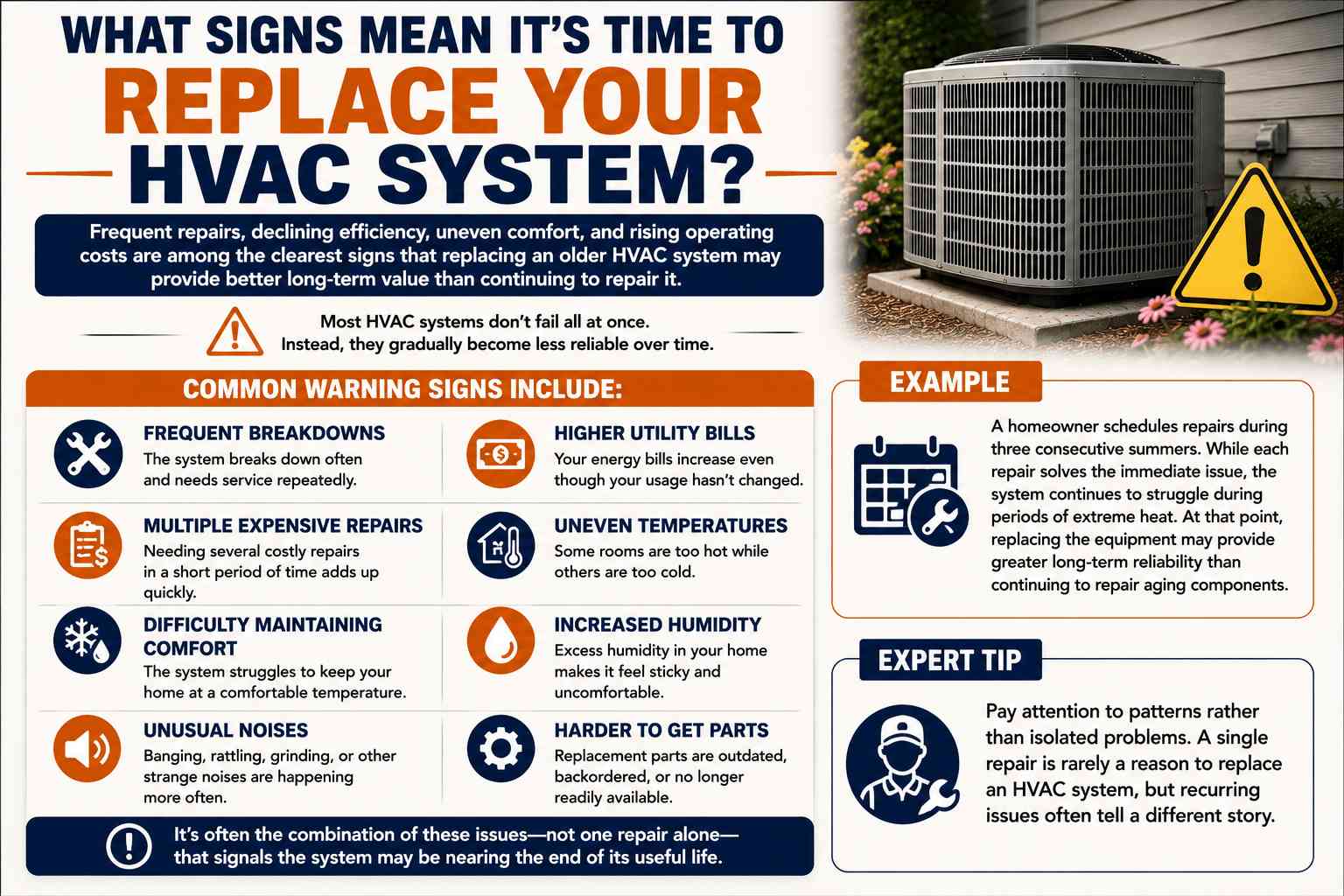
What Signs Mean It’s Time to Replace Your HVAC System?
Frequent repairs, declining efficiency, uneven comfort, and rising operating costs are among the clearest signs that replacing an older HVAC system may provide better long-term value than continuing to repair it.
Most HVAC systems don’t fail all at once. Instead, they gradually become less reliable over time.
Common warning signs include:
- Frequent breakdowns
- Multiple expensive repairs within a short period
- Higher utility bills without changes in energy use
- Uneven temperatures throughout the home
- Difficulty maintaining comfortable indoor temperatures
- Increased humidity during summer
- Unusual noises becoming more common
- Replacement parts becoming difficult to obtain
It’s often the combination of these issues – not one repair alone – that signals the system may be nearing the end of its useful life.
Example
A homeowner schedules repairs during three consecutive summers. While each repair solves the immediate issue, the system continues to struggle during periods of extreme heat. At that point, replacing the equipment may provide greater long-term reliability than continuing to repair aging components.
Expert Tip
Pay attention to patterns rather than isolated problems. A single repair is rarely a reason to replace an HVAC system, but recurring issues often tell a different story.
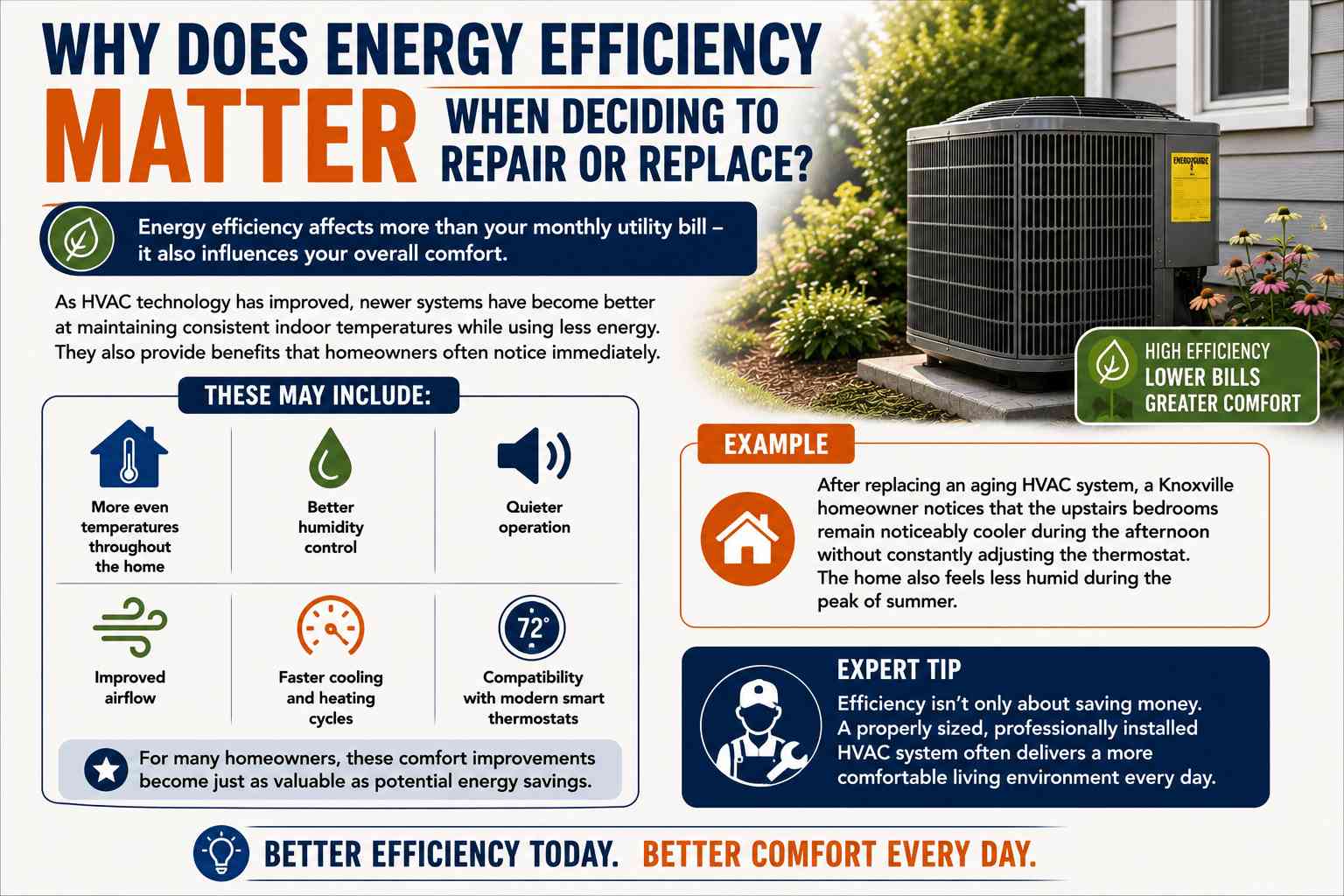
Why Does Energy Efficiency Matter When Deciding to Repair or Replace?
Energy efficiency affects more than your monthly utility bill – it also influences your overall comfort.
As HVAC technology has improved, newer systems have become better at maintaining consistent indoor temperatures while using less energy. They also provide benefits that homeowners often notice immediately.
These may include:
- More even temperatures throughout the home
- Better humidity control
- Quieter operation
- Improved airflow
- Faster cooling and heating cycles
- Compatibility with modern smart thermostats
For many homeowners, these comfort improvements become just as valuable as potential energy savings.
Example
After replacing an aging HVAC system, a Knoxville homeowner notices that the upstairs bedrooms remain noticeably cooler during the afternoon without constantly adjusting the thermostat. The home also feels less humid during the peak of summer.
Expert Tip
Efficiency isn’t only about saving money. A properly sized, professionally installed HVAC system often delivers a more comfortable living environment every day.
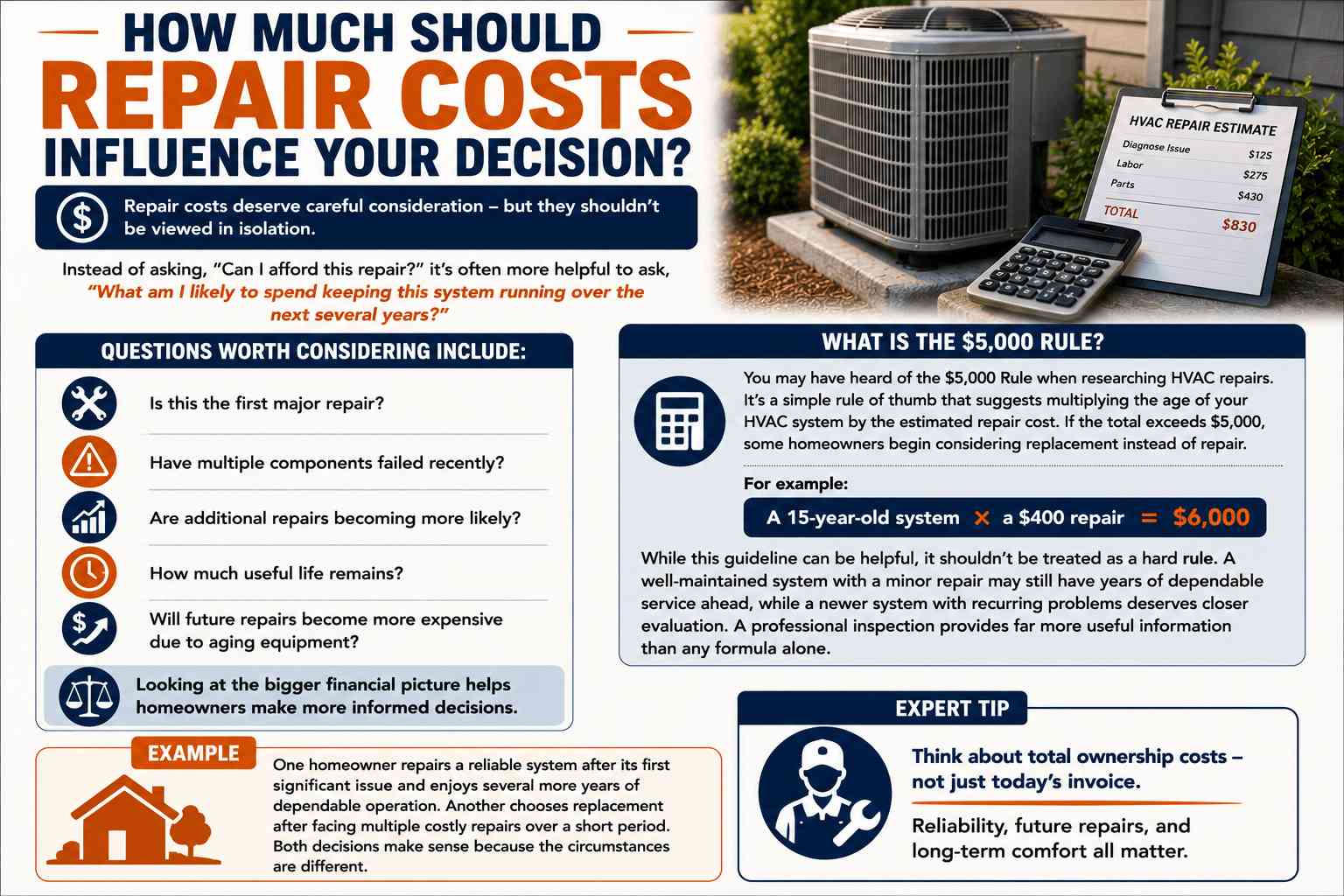
How Much Should Repair Costs Influence Your Decision?
Repair costs deserve careful consideration – but they shouldn’t be viewed in isolation.
Instead of asking, “Can I afford this repair?” it’s often more helpful to ask, “What am I likely to spend keeping this system running over the next several years?”
Questions worth considering include:
- Is this the first major repair?
- Have multiple components failed recently?
- Are additional repairs becoming more likely?
- How much useful life remains?
- Will future repairs become more expensive due to aging equipment?
Looking at the bigger financial picture helps homeowners make more informed decisions.
What Is the $5,000 Rule?
You may have heard of the $5,000 Rule when researching HVAC repairs.
It’s a simple rule of thumb that suggests multiplying the age of your HVAC system by the estimated repair cost. If the total exceeds $5,000, some homeowners begin considering replacement instead of repair.
For example:
- A 15-year-old system × a $400 repair = $6,000
While this guideline can be helpful, it shouldn’t be treated as a hard rule. A well-maintained system with a minor repair may still have years of dependable service ahead, while a newer system with recurring problems deserves closer evaluation.
A professional inspection provides far more useful information than any formula alone.
Example
One homeowner repairs a reliable system after its first significant issue and enjoys several more years of dependable operation. Another chooses replacement after facing multiple costly repairs over a short period. Both decisions make sense because the circumstances are different.
Expert Tip
Think about total ownership costs – not just today’s invoice. Reliability, future repairs, and long-term comfort all matter.
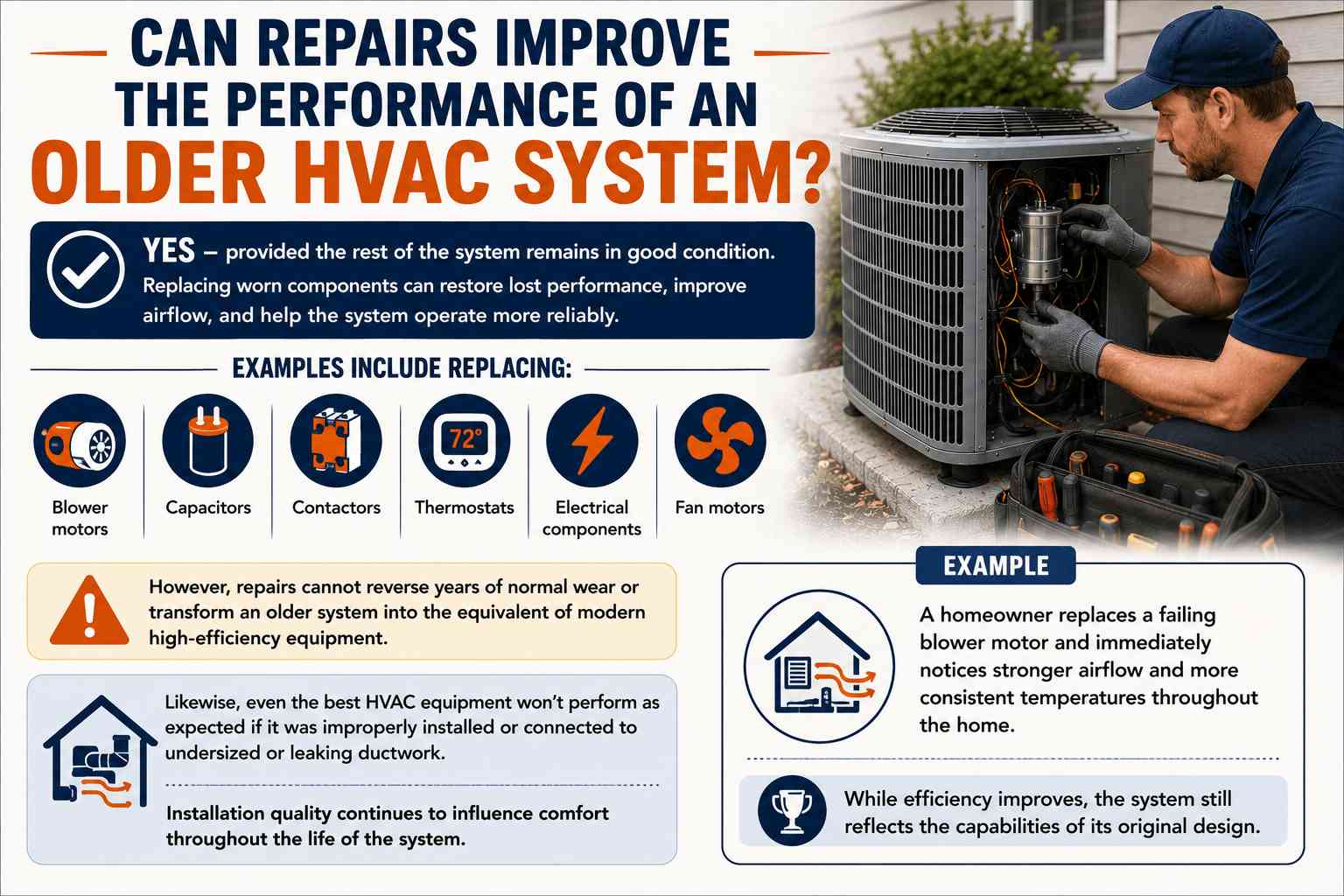
Can Repairs Improve the Performance of an Older HVAC System?
Yes – provided the rest of the system remains in good condition.
Replacing worn components can restore lost performance, improve airflow, and help the system operate more reliably.
Examples include replacing:
- Blower motors
- Capacitors
- Contactors
- Thermostats
- Electrical components
- Fan motors
However, repairs cannot reverse years of normal wear or transform an older system into the equivalent of modern high-efficiency equipment.
Likewise, even the best HVAC equipment won’t perform as expected if it was improperly installed or connected to undersized or leaking ductwork. Installation quality continues to influence comfort throughout the life of the system.
Example
A homeowner replaces a failing blower motor and immediately notices stronger airflow and more consistent temperatures throughout the home. While efficiency improves, the system still reflects the capabilities of its original design.
What Questions Should You Ask Before Making a Decision?
A trustworthy HVAC contractor should help you understand your options instead of steering you toward a predetermined solution.
Before approving a repair or replacement, consider asking:
- What caused the current problem?
- Is this repair expected to solve the issue completely?
- What condition is the rest of the system in?
- Are additional repairs likely within the next few years?
- Are replacement parts still readily available?
- Is the equipment still covered under any manufacturer warranty?
- Does the system use refrigerant that is becoming more difficult or expensive to obtain?
- What option provides the best value based on my long-term plans?
Having these conversations helps homeowners make informed decisions instead of reacting to an unexpected breakdown.
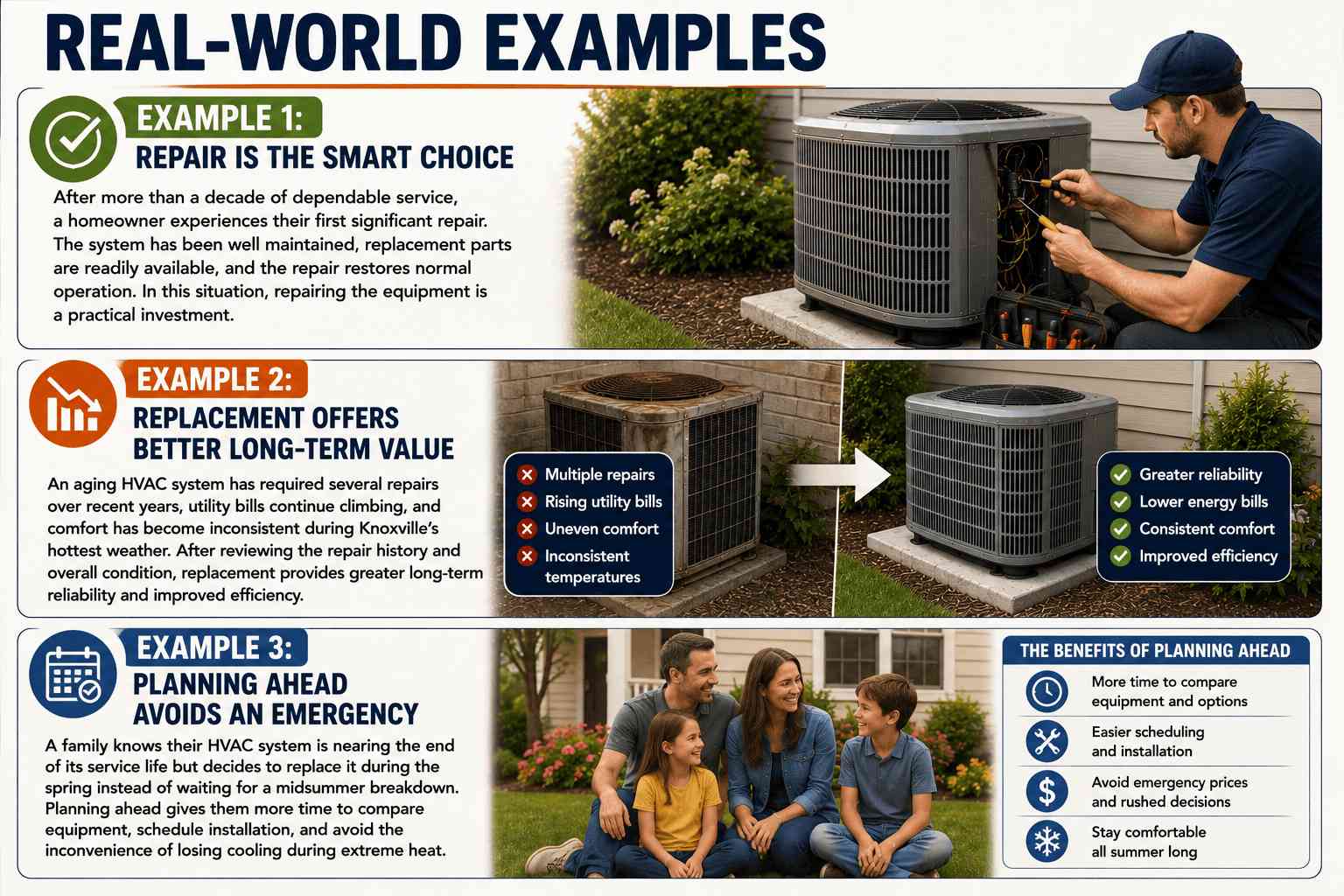
Real-World Examples
Example 1: Repair Is the Smart Choice
After more than a decade of dependable service, a homeowner experiences their first significant repair. The system has been well maintained, replacement parts are readily available, and the repair restores normal operation. In this situation, repairing the equipment is a practical investment.
Example 2: Replacement Offers Better Long-Term Value
An aging HVAC system has required several repairs over recent years, utility bills continue climbing, and comfort has become inconsistent during Knoxville’s hottest weather. After reviewing the repair history and overall condition, replacement provides greater long-term reliability and improved efficiency.
Example 3: Planning Ahead Avoids an Emergency
A family knows their HVAC system is nearing the end of its service life but decides to replace it during the spring instead of waiting for a midsummer breakdown. Planning ahead gives them more time to compare equipment, schedule installation, and avoid the inconvenience of losing cooling during extreme heat.
Expert Tips for Making the Right Decision
Choosing between HVAC repair and replacement isn’t about finding a one-size-fits-all answer. It’s about understanding your equipment and making the decision that best supports your comfort and budget.
As you evaluate your options:
- Review your repair and maintenance history.
- Consider the system’s overall reliability.
- Think beyond today’s repair cost.
- Factor in future repair risks.
- Consider your long-term plans for the home.
- Work with an HVAC contractor who explains every option clearly and without pressure.
A thoughtful decision today can help reduce unexpected expenses and improve your home’s comfort for years to come.
Conclusion
Deciding whether to repair or replace an older HVAC system involves much more than comparing one repair estimate with the cost of new equipment.
The best decision comes from evaluating the system’s overall condition, repair history, efficiency, remaining service life, and your family’s comfort needs. While many older systems continue performing well after the right repair, others eventually reach a point where replacement offers greater reliability and better long-term value.
A professional evaluation provides the information you need to make that decision with confidence.
If you’re trying to decide whether to repair or replace an older HVAC system, the experienced team at Chaffee HVAC, Plumbing & Electrical is here to help. We’ll perform a thorough inspection, explain your system’s condition in straightforward terms, and provide honest recommendations based on your home’s needs – not high-pressure sales tactics.
Whether a repair makes the most sense or you’re ready to explore HVAC replacement, we’ll help you understand your options so you can make a confident decision. Contact Chaffee HVAC, Plumbing & Electrical today to schedule an HVAC evaluation in Knoxville or the surrounding communities.
For expert help you can trust, contact Chaffee HVAC, Plumbing, & Electrical in Knoxville today to schedule your no-obligation electrical safety inspection.
Frequently Asked Questions
At what age should I consider replacing my HVAC system?
There isn’t a specific age when every HVAC system should be replaced. Maintenance history, repair frequency, installation quality, and overall performance often matter more than the number of years the equipment has been in service. A professional inspection can help determine whether your system still has dependable life remaining.
Is it worth repairing a 15-year-old HVAC system?
It can be, depending on the repair and the condition of the rest of the system. If the equipment has been reliable and the repair is relatively minor, repairing it may still be a sound investment. If major repairs have become frequent, replacement may offer better long-term value.
How do I know if my HVAC system is worth repairing?
Look at the complete picture rather than one repair estimate. Consider how often the system has required service, whether comfort has declined, how efficiently it operates, and whether additional repairs are likely. An experienced HVAC technician can help you weigh these factors.
Can an HVAC system last 20 years?
Some systems do reach or exceed twenty years of service, particularly when they’ve received regular maintenance and quality repairs. However, age alone doesn’t determine reliability. The condition of the equipment and how well it performs are more important indicators.
What are the most expensive HVAC components to replace?
Major components such as compressors, evaporator coils, heat exchangers, and blower motors are generally among the more significant repairs. The actual cost depends on the type of equipment, parts availability, and the complexity of the installation.
Should I replace both the indoor and outdoor units together?
In many cases, yes. Matching indoor and outdoor equipment is often recommended to achieve the best performance, efficiency, and manufacturer compatibility. Your HVAC contractor can advise whether replacing both units is appropriate for your specific system.
Can regular maintenance help extend my HVAC system's life?
Absolutely. Annual maintenance helps identify developing issues early, improves efficiency, and reduces unnecessary wear on major components. While maintenance can’t eliminate every repair, it often helps homeowners get the longest practical service life from their equipment.
Will replacing my HVAC system lower my utility bills?
Many homeowners notice lower energy consumption after upgrading from older equipment, particularly if the previous system had become less efficient. Actual savings vary depending on the equipment selected, installation quality, and how the system is used.
Should I replace my HVAC system before it completely fails?
Planning a replacement before a total breakdown often gives homeowners more flexibility. It allows time to compare equipment options, review financing if needed, and schedule installation before peak heating or cooling seasons create emergency situations.
Who should help me decide whether to repair or replace my HVAC system?
A licensed HVAC professional should inspect the equipment, evaluate its overall condition, review your repair history, and explain your options without pressure. The goal should be helping you choose the solution that provides the best long-term value for your home—not simply recommending the most expensive option.

Contact Us
Chaffee HVAC, Plumbing, & Electrical
5725 Ball Camp Pike
Knoxville, TN 37921
865-247-8888 – Cooling/Heating
865-602-3552 – Plumbing
office@coolingheatingplumbing.com
About Us
Your local HVAC company, Chaffee, bring decades of experience to our work. What this means to you as a customer is that you can expect to receive the highest-quality professional service, regardless of your needs.