(865)-247-8888
Commercial HVAC Maintenance Agreement: Why Knoxville Small Businesses Need One
Key Points
- A commercial HVAC maintenance agreement is a written plan for scheduled inspections, priority repairs, and service records on your business’s equipment.
- Maintenance programs are estimated to save 5% to 20% on energy bills, according to the U.S. Department of Energy’s FEMP program.
- The terms matter more than the price: response time, covered equipment, exclusions, term length, and cancellation.
- Not every business needs one. Tenants whose landlord handles HVAC may not.
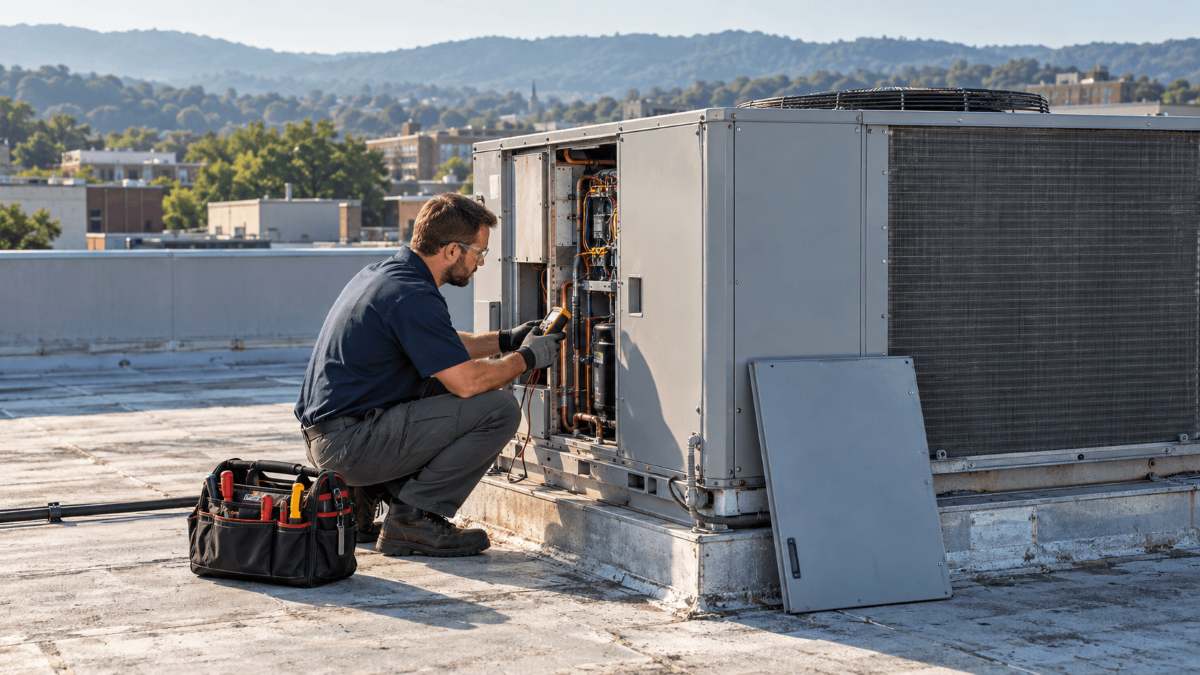
A commercial HVAC maintenance agreement is a contract in which a contractor inspects and services your equipment on a schedule, so small problems get caught before they close your doors.
For a small business, a cooling failure on a hot Knoxville afternoon can mean uncomfortable customers, spoiled stock, or a lost day of sales. Waiting for a breakdown means the repair happens on the equipment’s schedule, not yours.
This guide covers what an HVAC preventive maintenance contract includes, why small businesses use a commercial HVAC maintenance plan, which terms to review before signing, what drives the cost, and when you can skip one.
What Does a Commercial HVAC Maintenance Agreement Include?
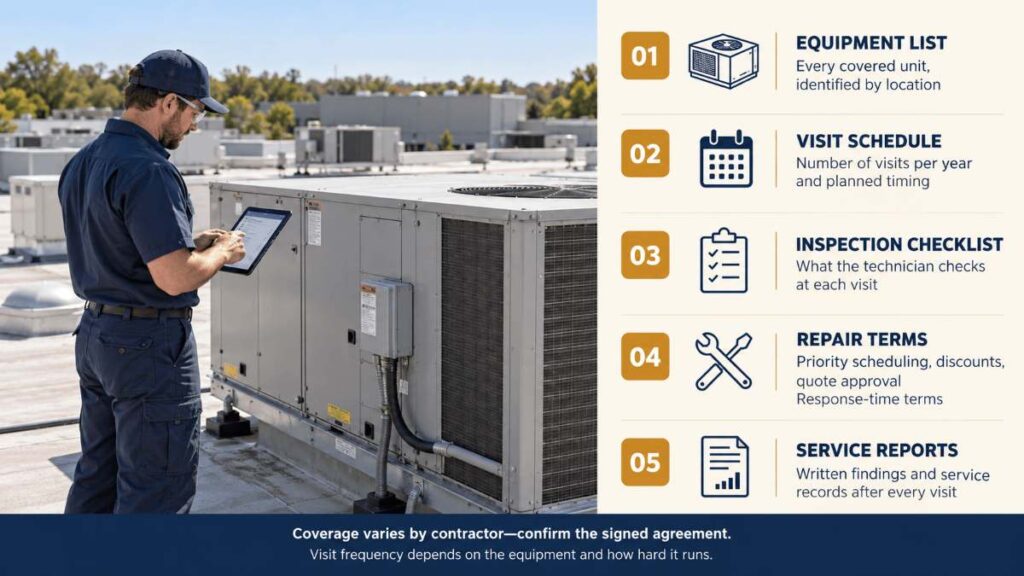
A commercial HVAC maintenance agreement usually includes scheduled inspections and tune-ups, a written list of the equipment covered, priority scheduling for repairs, and service records. Contents vary by contractor, so the signed contract matters more than the sales pitch you hear.
Common pieces include:
-
- Equipment list: every unit, listed by location
- Visit schedule: how many visits per year, and when
- Inspection checklist: what the technician checks each visit
- Repair terms: discounts, quote approval, and response time
- Reports: written notes after every visit
Chaffee’s maintenance services cover homes and small businesses.
For a benchmark, ASHRAE Standard 180 sets minimum HVAC inspection and maintenance requirements for commercial buildings. Its goal is to preserve thermal comfort, energy efficiency, and indoor air quality. A small shop’s plan will be simpler than a full building program.
How often visits should happen depends on the equipment and how hard it runs. We cover that in How Often Should Commercial HVAC Be Serviced?.
Why Do Knoxville Small Businesses Need a Maintenance Agreement?
Fewer Breakdowns During Business Hours
Reactive maintenance is the “run it until it breaks” approach. Preventive maintenance follows a time-based schedule. The Pacific Northwest National Laboratory says studies indicate preventive savings of as much as 12% to 18% on average compared with reactive maintenance. Those figures come from general facility studies, not a promise for one shop.
Say a shop earns $300 an hour and closes for 6 hours while it waits on a repair. That is $1,800 in lost sales before the repair bill. These numbers are an assumed example, so plug in your own.
Lower Energy Bills and Fewer Replacement Surprises
The Department of Energy’s Federal Energy Management Program says well-executed operations and maintenance programs can save 5% to 20% on energy bills. That program covers federal facilities, so your results will differ.
Regular visits also give you an early read on aging equipment. You can budget for a replacement instead of facing one in the middle of July.
Comfort and a Paper Trail
Customers and employees notice a hot or stuffy room. Service reports also record what was inspected and when. Check your equipment warranty and your lease to see whether either one asks for documented maintenance.
How Does a Commercial HVAC Maintenance Agreement Work? What to Expect in Year One
Here is the usual sequence:
-
- Site visit and equipment inventory: The technician records the make, model, age, location, and condition of each unit.
- Written scope and schedule: The contract lists which units are covered, how many visits you get, and what each visit includes.
- Scheduled visits: Visits are planned around your business hours.
- Service reports: After each visit, you get notes and any recommended repairs, with a quote before work starts.
- Priority repair calls: Breakdowns follow the response terms in your contract.
- Renewal review: You go over what was found, what to replace, and whether to change the scope.
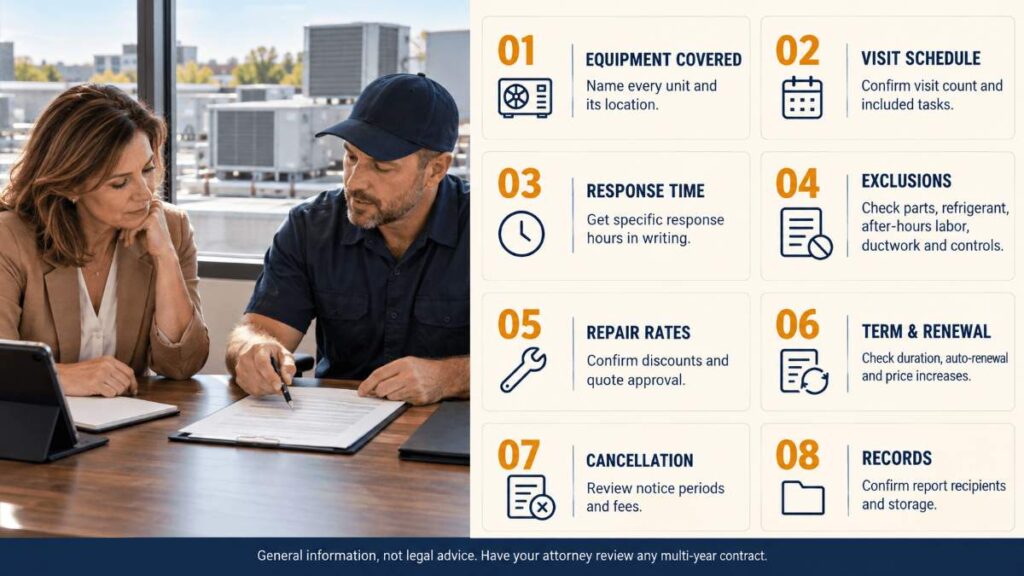
HVAC Preventive Maintenance Contract Terms to Review Before You Sign
Most agreement explainers skip the fine print, and that’s where the surprises are. Read these terms twice:
-
- Equipment covered: Every unit should be named and located.
- Visit schedule: Look for the number of visits and what each one includes.
- Response time: Get it in writing. “Priority service” without hours attached means little.
- Exclusions: Check whether parts, refrigerant, after-hours labor, ductwork, and controls are covered.
- Repair rates: Ask about discounts and how quotes get approved.
- Term and renewal: Note the length, auto-renewal, and any price increases.
- Cancellation: Know the notice period and any fees.
- Records: Confirm who gets the service reports and where they are kept.
This is general information, not legal advice. Have your attorney review any multi-year contract.
What Affects the Cost of a Commercial HVAC Maintenance Agreement?
Pricing is quoted per building, not as a flat number. These factors move it most:
-
- Number and type of units: Rooftop units, split systems, mini splits, and heat pumps differ in workload.
- Age and condition: Older equipment often needs more attention.
- Visits per year: More visits mean a higher annual cost.
- Access: Roof access and tight equipment rooms add time.
- Scope and response level: Faster response and broader coverage cost more.
Maintenance Agreement vs. Pay-Per-Visit Service: Which Is Better for Your Business?
| Approach | How it works | Cost pattern | Best for | Watch out for |
| Run to failure | You call when it breaks | Low until a failure, then high and unplanned | Rarely a good fit | Downtime at the worst moment |
| Pay-per-visit tune-ups | You book each visit yourself | Predictable per visit, no priority | A few units and a flexible schedule | Skipped visits, no priority repair |
| Maintenance agreement | Scheduled visits under contract | Planned yearly cost | Businesses where downtime hurts | Exclusions, renewals, cancellation terms |
An agreement trades some flexibility for scheduling discipline and priority service.
Is a Commercial HVAC Maintenance Agreement Worth It for Your Business?
It is worth pricing if a failed unit would close or empty your space. That includes restaurants, retail shops, offices, clinics, and salons.
Another option can be better in a few cases:
-
- Your landlord handles HVAC. Check your lease first.
- Your equipment is new and under warranty. Read the warranty to see what upkeep it requires.
- You’re in a short-term space. A long contract may not fit.
- You have one or two units and a flexible schedule. Pay-per-visit may be enough.
If you’re unsure, ask Chaffee for a site walk-through and compare the quote against your own downtime math.
Expert Tips for a Commercial HVAC Maintenance Agreement
-
- Get the equipment list in writing, and walk the site with the technician once.
- Ask what “priority service” means in hours, and put it in the contract.
- Keep every service report in one folder for warranty, lease, and budget needs.
- Use the renewal meeting to plan replacements, so no unit surprises your budget.
Conclusion: Commercial HVAC Maintenance Agreement
A commercial HVAC maintenance agreement is worth having when downtime would cost you more than the plan does. Read the terms, get response times in writing, and match the plan to your business.
Ready for a quote? Request a maintenance walk-through from Chaffee HVAC, Plumbing and Electrical through our maintenance page or call (865)-247-8888 for faster service.
For expert help you can trust, contact Chaffee HVAC, Plumbing, & Electrical in Knoxville today to schedule your no-obligation electrical safety inspection.
Frequently Asked Questions
What is a commercial HVAC maintenance agreement?
A commercial HVAC maintenance agreement is a contract for scheduled inspections, priority service, and records on the equipment it lists. The terms vary by contractor, so compare scope, response time, and renewal rules before you sign.
What does an HVAC maintenance agreement cover for a small office or retail shop?
It covers the units listed in the contract, scheduled inspections, and written reports. Repair terms and exclusions vary, so read them closely.
Is a preventive maintenance contract the same as a service plan?
Usually, yes. Companies use different names for similar plans, so compare the scope, response time, and terms instead of the label.
Can I cancel a commercial HVAC maintenance agreement early?
It depends on your contract. Look for the term length, notice period, and any early-exit fees before you sign.
How much does a commercial HVAC maintenance agreement cost in Knoxville?
It depends on the number of units, their type and age, and how many visits you want.
Is a maintenance agreement better than paying per visit?
An agreement fits businesses where downtime hurts. Pay-per-visit can work if you have a few units and a flexible schedule. The comparison table above shows the trade-offs.
Who handles HVAC maintenance if I lease my space?
That depends on your lease. Ask your landlord or attorney who is responsible for HVAC before you sign anything. If it falls to you, a contractor can inspect the equipment and set up a plan.

Contact Us
Chaffee HVAC, Plumbing, & Electrical
5725 Ball Camp Pike
Knoxville, TN 37921
865-247-8888 – Cooling/Heating
865-602-3552 – Plumbing
office@coolingheatingplumbing.com
About Us
Your local HVAC company, Chaffee, bring decades of experience to our work. What this means to you as a customer is that you can expect to receive the highest-quality professional service, regardless of your needs.