(865)-247-8888
Fall Allergies and Your HVAC System: Managing Ragweed Season Indoors in Knoxville
Key Points
-
- Ragweed season runs from about August until the first frost, and peaks in mid-September in most areas, according to AAFA.
- A clean, properly rated filter helps, but EPA says filtration supplements source control and ventilation. It does not replace them.
- EPA says to use at least a MERV 13 filter, or the highest rating your system can accommodate.
- HVAC changes are not medical treatment. If symptoms are persistent or involve asthma, see an allergist.
Introduction
Fall allergies and your HVAC system are connected because your system moves indoor air through a filter all day. A clean, well-chosen filter, closed windows, and humidity control can reduce the pollen you breathe at home.
Ragweed is the main fall trigger. The Asthma and Allergy Foundation of America (AAFA) says one ragweed plant can produce up to 1 billion pollen grains, and the season lasts until the first frost. Your HVAC system can’t clear outdoor air, and it only helps while it runs with a good filter.
This guide covers what your system can and can’t do, how to set it up for ragweed season, which HVAC air filter for allergies to choose, and what to skip.
Fall Allergies and Your HVAC System: What Can It Actually Do?
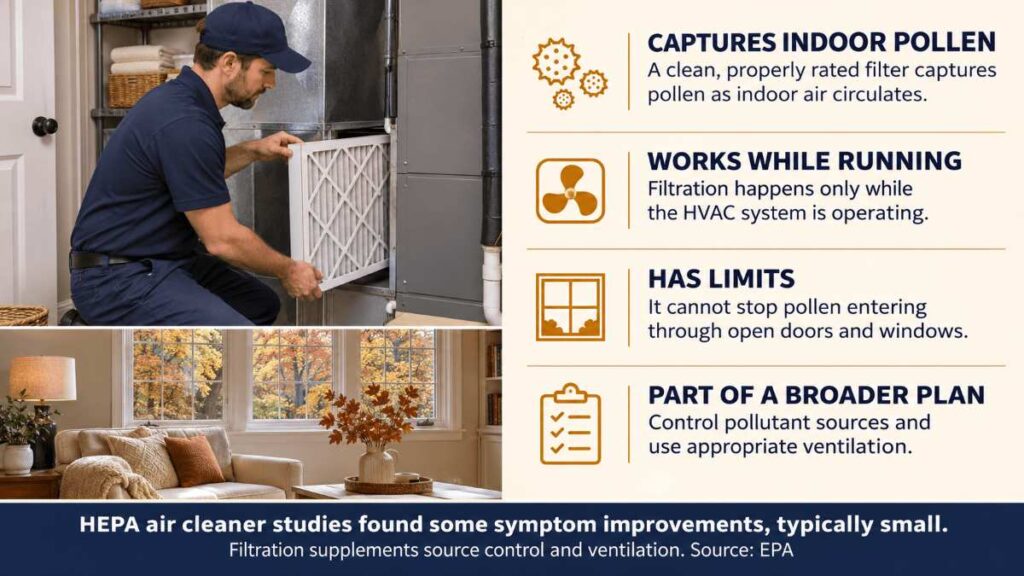
Your system filters indoor air as it circulates. A clean filter with a good rating captures pollen that gets inside, but it can’t stop pollen from coming through open doors and windows, and the EPA notes it only filters while the system is running.
Keep expectations honest. EPA says filtration does not replace the need to control pollutants and ventilate. Studies of HEPA air cleaners found improvements in some symptoms, but the improvements were typically small.
Chaffee’s indoor air quality services cover filtration and humidity control.
Why Is Ragweed Season Hard on Knoxville Homes?
Three things make fall tough indoors.
When Ragweed Season Starts and Ends
AAFA says ragweed season starts around August, may last six to 10 weeks, and usually peaks in mid-September. Symptoms may continue until the first frost kills the plant. The National Weather Service puts Knoxville’s median first frost at October 24, based on 1991-2020 normals, so the date varies by year.
A local allergist told WVLT that ragweed now appears in early August. The same report cites AAFA’s 2026 Allergy Capitals ranking, where Knoxville placed 21st worst.
How Pollen Gets Inside
Pollen comes in through open windows and doors, on shoes and clothes, and on pets. AAFA says long-haired pets can carry it in. Take shoes off at the door, skip outside clothes in bed, and shower after long periods outdoors.
Mold and Humidity
Fall can stay damp, and damp air feeds mold and dust mites. EPA says to keep indoor humidity below 60 percent, ideally between 30 and 50 percent. A hygrometer is the easy way to check.
How Do You Set Up Your HVAC for Ragweed Season? What to Do, Step by Step
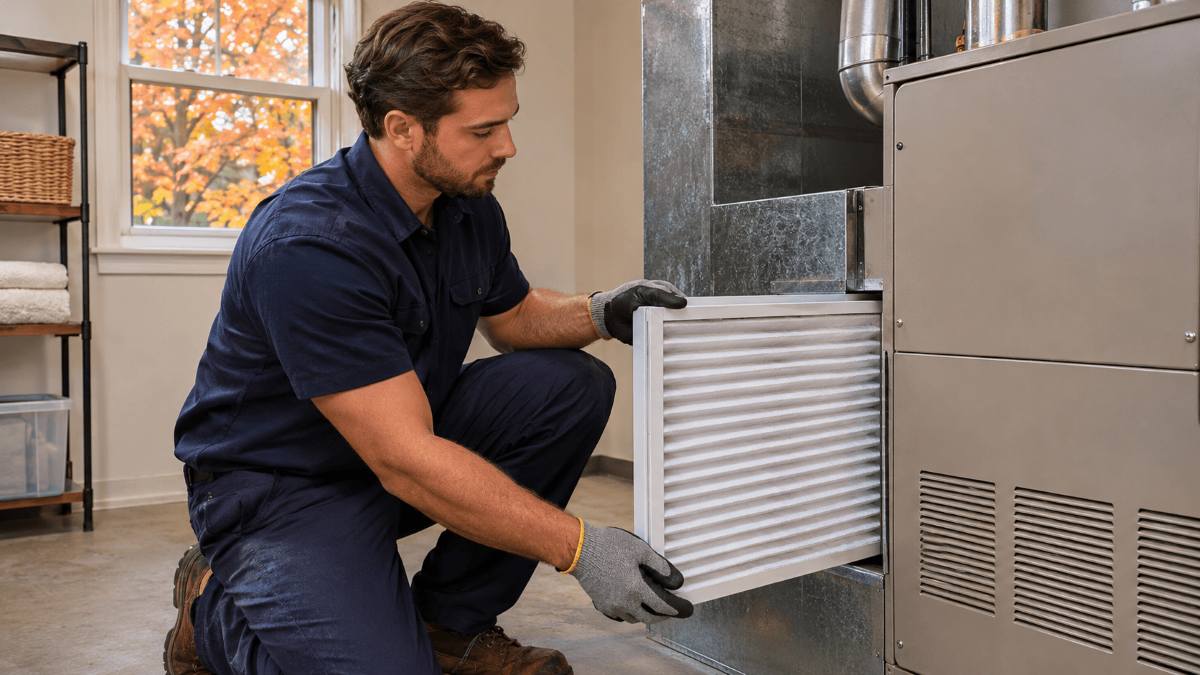
- Check your filter size. Ask a technician for the highest rating your system can handle.
- Choose the right MERV rating. EPA says at least MERV 13, or as high as your system will accommodate.
- Replace it on schedule. EPA says manufacturers typically call for every 60 to 90 days, sooner if it looks heavily soiled.
- Keep windows and doors closed on high-pollen days. Set the AC or fan to recirculate, as AAFA advises.
- Check any fresh-air filter. The Department of Energy says to filter the intake if fresh air is ducted to the air handler.
- Track pollen counts. AAFA points to the National Allergy Bureau and pollen apps.
- Book your fall tune-up before the first frost.
HVAC Air Filter for Allergies: Which MERV Rating Should You Use?
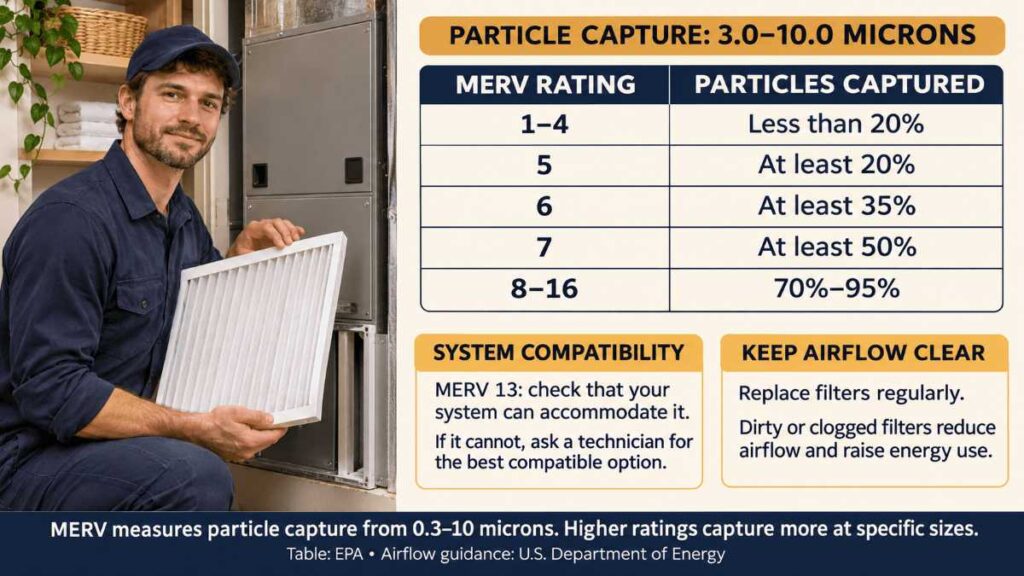
EPA says MERV reports a filter’s ability to capture particles between 0.3 and 10 microns. The higher the rating, the better it traps specific sizes. The Department of Energy says filters rated MERV 6 and above can capture pollutants such as pollen, dust mites, and mold spores.
EPA’s table for larger particles (3.0 to 10.0 microns) shows the range:
| MERV rating | Share of particles captured |
| 1 to 4 | Less than 20% |
| 5 | At least 20% |
| 6 | At least 35% |
| 7 | At least 50% |
| 8 to 16 | 70% to 95% |
EPA says most systems can handle a MERV 13 filter without equipment problems if you replace it frequently. A dirty or clogged filter can dramatically cut airflow and raise energy use, the Department of Energy warns.
If your system can’t take a MERV 13, don’t force it. Ask a technician for the next best option.
What Else Helps, and What Should You Skip?
Humidity control. A whole-home dehumidifier targets mold and dust mites, not ragweed. See Chaffee’s whole-home dehumidifier page.
A portable HEPA air cleaner. It filters one room. Choose one with a CADR large enough for the space.
What to skip. EPA says to avoid portable air cleaners and HVAC filters that intentionally produce ozone. It adds that ion generators may be relatively ineffective against large particles such as pollen. If a product claims allergy relief, ask for its ozone emissions information.
Filter vs. Portable HEPA vs. Whole-Home Options: Which Helps Most?
| Option | What it does | Best for | Limits |
| Upgraded HVAC filter (MERV 13 if compatible) | Filters air throughout the home while the system runs | Most homes with central HVAC | Must suit your system; replace regularly |
| Portable HEPA air cleaner | Filters one room | Bedrooms and rooms where symptoms are worst | One room only; improvements are typically small |
| Whole-home dehumidifier | Lowers indoor humidity | Mold and dust mite concerns | Doesn’t remove ragweed pollen |
Start with the filter. It’s the lowest-cost step.
Who Should Do More Than Change the Filter?
If your symptoms are mild, a good filter, closed windows, and a shower after time outdoors may be enough.
If symptoms are persistent, involve asthma, or disturb your sleep, see an allergist. AAFA says to start allergy medicine at least two weeks before the season begins. HVAC changes are a supplement to care, not a replacement.
If your system can’t take a higher MERV filter, a portable HEPA cleaner in the bedroom may be the better move. If you rent, change the filter if the lease allows it, or ask your landlord.
Expert Tips for Fall Allergies and Your HVAC System
-
- Check the pollen count and keep windows closed on high days.
- Replace the filter before the season peaks, then again on schedule.
- Set the AC or fan to recirculate when windows are closed.
- Ask a technician to confirm the highest MERV rating your system can use.
Conclusion: Fall Allergies and Your HVAC System
Fall allergies and your HVAC system work best together when you use a clean, properly rated filter, keep windows closed on high-pollen days, and control humidity. Know the limits, and see an allergist if symptoms persist.
Ready for a check? Schedule a fall tune-up or indoor air quality visit with Chaffee HVAC, Plumbing and Electrical through our indoor air quality page. You can also call (865)-247-8888 for faster service.
For expert help you can trust, contact Chaffee HVAC, Plumbing, & Electrical in Knoxville today to schedule your no-obligation electrical safety inspection.
Frequently Asked Questions
Can my HVAC system help with fall allergies?
Yes, as a supplement. With fall allergies and your HVAC system, a clean filter with a good rating, closed windows, and humidity control reduce indoor pollen and mold. They don’t replace allergy care.
How often should I change my air filter during ragweed season?
EPA says manufacturers typically recommend every 60 to 90 days, and sooner if the filter looks heavily soiled. Check it monthly during the season.
What MERV rating is best for allergies?
EPA says to choose at least MERV 13 or as high as your system can accommodate. Ask a technician to confirm what fits.
Should I keep my windows closed during ragweed season?
Yes, on high-pollen days if you can. AAFA also advises setting the AC to recirculate.
When does ragweed season end in Knoxville?
AAFA says symptoms may continue until the first frost kills the plant. The National Weather Service median first frost is October 24, but it varies each year.
Is a HEPA air cleaner better than an HVAC filter?
They do different jobs. A portable HEPA unit covers one room, while an HVAC filter covers the whole home but only while the system runs.
Do ionizing or ozone air purifiers help with allergies?
EPA says to avoid products that intentionally produce ozone. It adds that ion generators may be relatively ineffective against large particles such as pollen.

Contact Us
Chaffee HVAC, Plumbing, & Electrical
5725 Ball Camp Pike
Knoxville, TN 37921
865-247-8888 – Cooling/Heating
865-602-3552 – Plumbing
office@coolingheatingplumbing.com
About Us
Your local HVAC company, Chaffee, bring decades of experience to our work. What this means to you as a customer is that you can expect to receive the highest-quality professional service, regardless of your needs.